
MoneyByte Points
- Removing PFAS from water transfers the chemicals into another waste stream; it does not necessarily destroy them.
- EPA’s April 2026 guidance identifies certain hazardous-waste combustors, hazardous-waste landfills, and Class I injection wells as lower-release options under appropriate site-specific conditions.
- EPA does not endorse one universal solution. Its guidance is nonbinding, acknowledges remaining uncertainties, and introduces a framework for evaluating emerging technologies.
Removing PFAS from water transfers the chemicals into another waste stream; it does not necessarily destroy them.
EPA’s April 2026 guidance identifies certain hazardous-waste combustors, hazardous-waste landfills, and Class I injection wells as lower-release options under appropriate site-specific conditions.
EPA does not endorse one universal solution. Its guidance is nonbinding, acknowledges remaining uncertainties, and introduces a framework for evaluating emerging technologies.
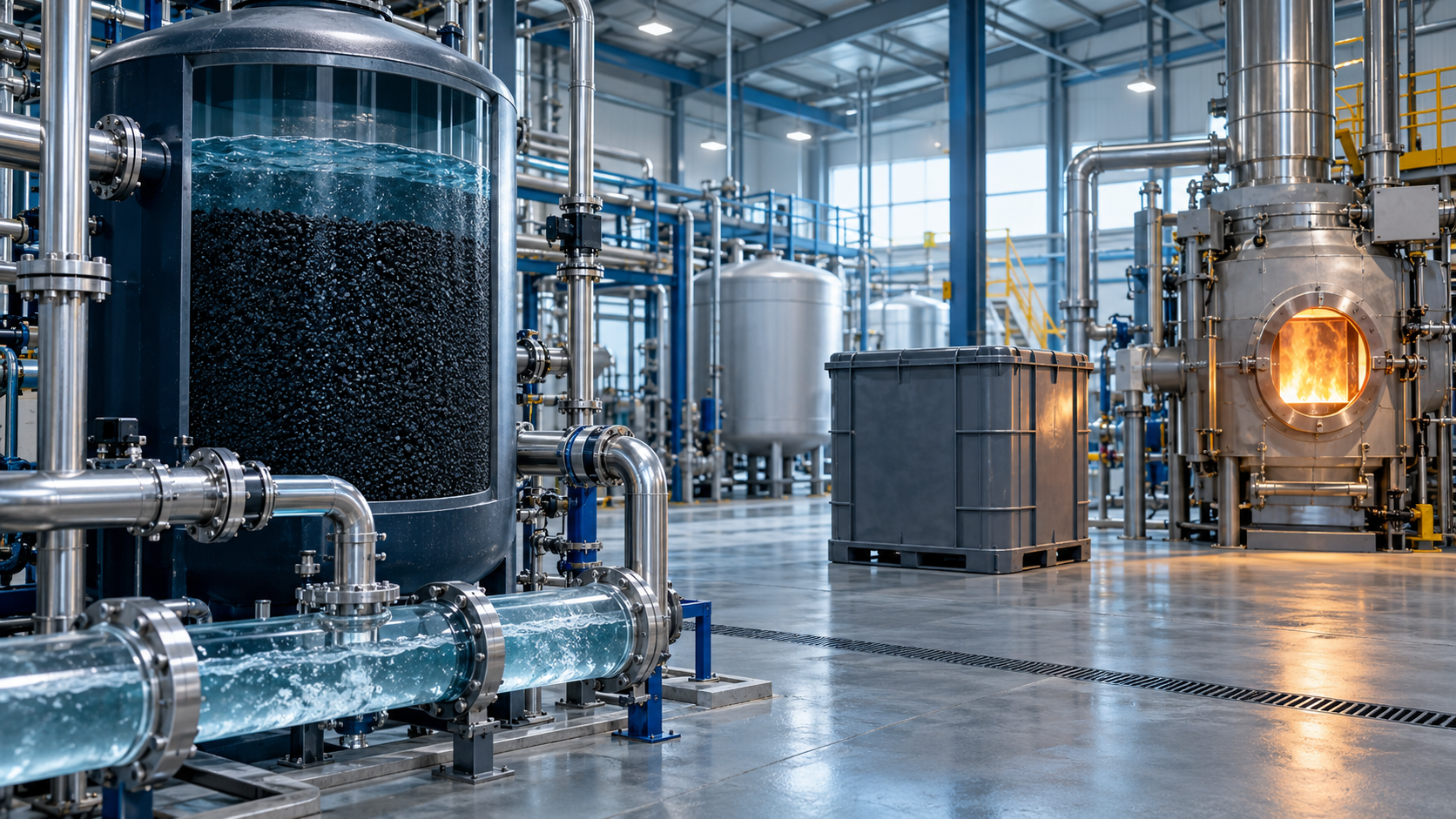
Removing PFAS from contaminated water is only the beginning of the engineering problem. Filtration and separation can produce cleaner water, but the captured chemicals remain in spent media, sludge, foam, or concentrated liquid.
Removing PFAS from water transfers the chemicals into another waste stream; it does not necessarily destroy them.
EPA’s April 2026 guidance identifies certain hazardous-waste combustors, hazardous-waste landfills, and Class I injection wells as lower-release options under appropriate site-specific conditions.
That makes PFAS destruction and disposal a separate design decision. Engineers must determine whether a waste stream will be destroyed, isolated from the environment, or merely transferred somewhere else.
The distinction became clearer when the U.S. Environmental Protection Agency released updated interim guidance on April 23, 2026. The document evaluates established options while emphasizing that site conditions, waste characteristics, emissions, and uncertainty all matter.
Why PFAS removal is not destruction
PFAS are a large family of persistent chemicals. Their stability has made them useful in many products, but it also makes them difficult to break down. The EPA’s PFAS overview notes that many PFAS components degrade very slowly in the environment.
A treatment system may successfully separate PFAS from millions of gallons of water while creating a much smaller—but more concentrated—waste stream. That concentration step can make subsequent management more practical, but it should not be confused with destruction.
The complete treatment train therefore has two questions:
- How will PFAS be removed or concentrated?
- What will happen to the resulting PFAS-containing material?
A credible engineering proposal should answer both.
What changed in EPA’s 2026 guidance
The 2026 EPA guidance updates the agency’s 2024 version using information reviewed through September 2025. It applies to non-consumer PFAS materials such as firefighting foam, contaminated media and certain water-treatment wastes.
The update introduces a framework for evaluating new destruction and disposal technologies. It also discusses three established, large-capacity pathways:
- Thermal treatment under specific operating conditions.
- Disposal in engineered landfills.
- Underground injection into permitted wells.
EPA’s guidance is nonbinding. It does not establish a universal disposal requirement or declare one technology best for every waste stream. Instead, EPA recommends selecting options with a lower potential for environmental release under the specific conditions involved.
Thermal treatment: promising, but conditions matter
Thermal treatment is the only one of EPA’s three established pathways intended to destroy the PFAS molecules rather than contain them.
EPA reports that research since 2024 produced promising results for certain permitted hazardous-waste combustors and some granular activated-carbon reactivation units operating under suitable conditions. However, that conclusion does not apply automatically to every furnace or incinerator.
The agency says uncertainties remain around units operating at lower temperatures, including municipal waste combustors. These uncertainties include possible PFAS emissions and harmful products of incomplete combustion.
EPA therefore encourages facilities to conduct appropriate testing before accepting large quantities of PFAS waste. A high combustion temperature alone is not enough to prove complete destruction; residence time, mixing, waste composition, emissions controls and measurement methods also affect performance.
Landfills and underground injection contain PFAS
A permitted Resource Conservation and Recovery Act Subtitle C hazardous-waste landfill uses stricter engineering controls than ordinary municipal disposal. EPA recommends considering this type of facility when landfill disposal is selected for relatively high-concentration PFAS waste.
Even so, landfilling is containment—not destruction. EPA’s 2026 PFAS guidance fact sheet says newer information suggests that PFAS releases from all landfill types could be greater than understood in 2024. Potential pathways include leachate and landfill gas.
Class I injection wells provide another containment option for compatible liquid wastes. Their construction, operating and monitoring requirements are designed to isolate waste deep below the surface and protect underground drinking-water sources. However, suitable wells are not available everywhere, and injection does not eliminate PFAS.
The engineering comparison is therefore not simply “safe” versus “unsafe.” It is a comparison of destruction performance, containment integrity, transportation, monitoring, capacity, cost and potential release pathways.
How emerging technologies should be evaluated
New processes may use electrical, chemical, mechanical, plasma or high-pressure thermal mechanisms to break PFAS bonds. Laboratory removal percentages can look impressive, but commercial decisions require more evidence.
A practical evaluation should ask:
- Was the technology tested on the actual waste matrix or only clean laboratory water?
- Which PFAS compounds were measured before and after treatment?
- Were air emissions, liquid effluent and solid residuals all analyzed?
- Could the process create shorter-chain PFAS or other incomplete-destruction products?
- Was fluorine accounted for across the complete treatment system?
- What energy, chemicals and maintenance are required per unit of waste?
- Has performance been independently verified at the proposed scale?
- What waste remains after the destruction stage?
A reduction in measured target compounds does not necessarily demonstrate complete mineralization. The compounds may have moved into another phase or transformed into substances that were not included in the analysis.
The engineering decision is a treatment train
Effective PFAS destruction and disposal begins with characterizing the waste: its volume, concentration, physical form, PFAS composition and other contaminants. Those characteristics determine whether concentration, transportation, thermal treatment, containment or a combination is practical.
A dilute water stream, spent activated carbon and concentrated firefighting foam should not automatically receive the same solution. Engineers should compare the entire chain—from initial separation through final residual management—rather than evaluating a single equipment package in isolation.
EPA’s update does not close the PFAS treatment question. It provides a more structured way to compare established options and test emerging claims while the underlying science continues to develop.
This environmental-infrastructure topic expands Money Byte’s technology coverage. Readers can also browse the latest Money Byte articles for related business and technology analysis.
Leave a Reply